Not All Coolants are Alike
How Delo® ELC Advanced exceeds performance expectations
Operators of heavy-duty diesel equipment – whether on-highway, off-road or stationary – rely heavily on coolants to minimize the risk of damage, extend maintenance intervals and service life, and generally operate efficiently. Yet they may not be aware of the formulation expertise that goes into a coolant, or what makes one coolant different from another. In fact, coolant chemistry has become increasingly sophisticated. Much like engine oil, coolants have had to evolve as engine technology has changed to meet higher fuel economy and carbon emission standards.
For example, when engine OEMs began shifting from copper and brass to aluminum radiators, traditional nitrite-based and extended life coolants were found to have a negative reaction with aluminum that was “unpassivated,” or lacking a protective oxide coating. Moreover, conventional coolants are prone to silicate buildup and scale formation, which can block passageways and significantly reduce heat transfer efficiency. To counteract these issues, Chevron developed Delo® ELC Advanced Extended Life Coolant, an ethelyne glycol-based nitrited organic additive technology (NOAT) solution specifically engineered to mitigate these adverse effects. Delo ELC Advanced is intended for both on- and off-highway applications
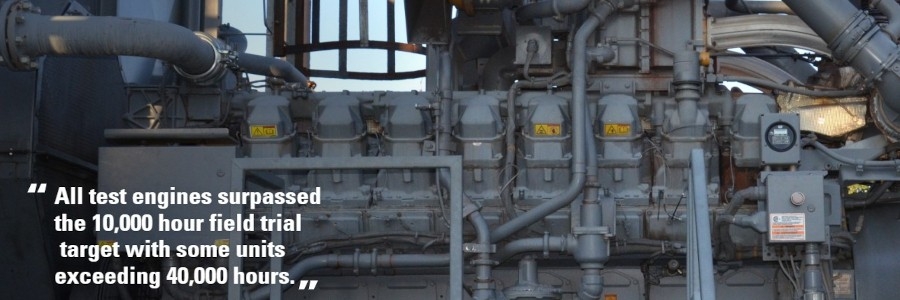
More recently, to evaluate the real-world, long-term performance of Delo ELC Advanced, we worked with a customer to conduct a two-year field test in stationary natural gas engines, specifically the Caterpillar 3500/3600 and GE Waukesha Series Four gas compression engines. The goal was to see how well the coolant performed on corrosion for a minimum test duration of 10,000 hours. We evaluated such metrics as pH levels (a measure of relative acidity), corrosion inhibitor properties, water content, and the presence of metal deposits in the fluid, a key indicator of corrosion.
The results far exceeded our goal and our customers’ expectations. The Delo ELC Advanced formula was found to maintain sufficient concentrations of corrosion inhibitors up to 20,000 hours – and even exceeding 40,000 hours in some test engines. Water content and pH levels remained stable well over the 10,000 hour mark. Based on these results, we can confidently project a service life of 1.5 million miles, in on-highway applications, 20,000 hours in off-highway diesel engines, and 32,000 in stationary engines. It’s worth noting that the customer who took part in this test has now converted to Delo ELC Advanced coolant for its entire fleet.
Of course, we always advise following the OEM’s coolant maintenance recommendations and conducting periodic coolant testing. The key takeaway: don’t take your coolant for granted. Formulation does make a difference. With the right product and a professional maintenance program, you can trust your coolant to protect your equipment over its entire life.
03/26/2026